The Tax Benefits That Homeowners Can Enjoy
February 15, 2024
February 15, 2024
Is this your first year filing your taxes as a homeowner? If yes, then you're in for some sweet treats. There are certain deductions you are entitled to and can take advantage of to lower your tax bill. Some of these tax breaks can be a one-time deduction or recurring on the life of your mortgage.
For buyers who are still contemplating whether owning a home is worth it, this is another good reason that might help with your decision. Aside from building wealth through home equity, owning a home can pay off at tax time.
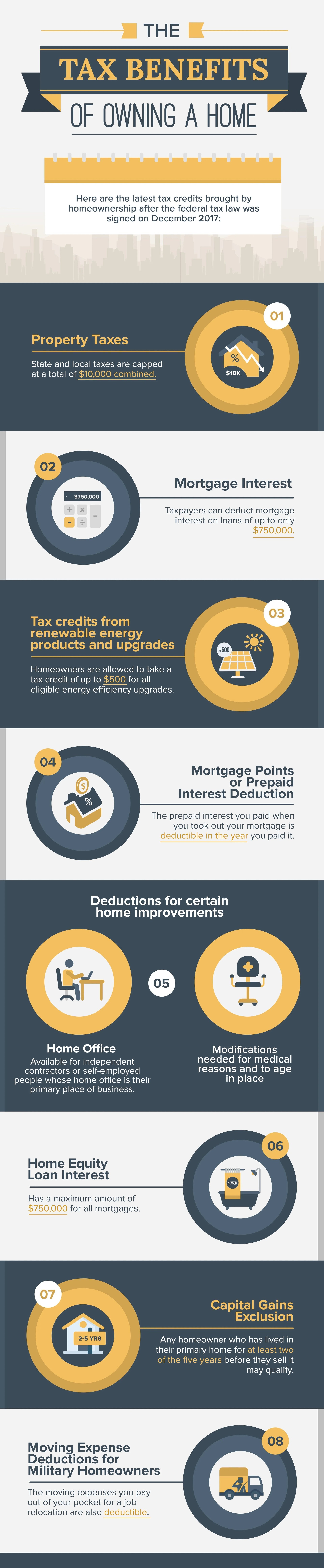
And while itemizing tax deductions can be very complicated — homeowner or not — they are worth remembering so you can avoid missing out. Here are the latest tax credits brought by homeownership after the federal tax law was signed in December 2017:
Back in 2017, the deductions for property taxes were unlimited. All of your property taxes are deductible so if you live in an area where the property taxes are high, you could wind up deducting thousands of dollars.
But for tax year 2018 and beyond, state and local taxes are capped at a total of $10,000 combined. This includes property, income, or sales taxes.
Likewise, this tax deduction can still be helpful for your finances, although it can be tricky in the year you bought the home. You as the buyer and new homeowner will only get to deduct the property taxes you owed for the portion of the year you owned the home. The seller gets the rest of the deduction, regardless if you offered to pay the full year of property taxes during negotiations.
Many homeowners can deduct the interest portion of their monthly mortgage payments each year. It remains as a deductible under the new tax plan but with a new cap. Taxpayers are now allowed to deduct mortgage interest on loans of up to only $750,000, compared to the previous $1 million. The maximum mortgage debt on which you can deduct the interest also applies to secondary or vacation homes.
Homeowners who have installed alternative energy upgrades in their homes may qualify for tax credits as long as the products installed are also eligible. Most of these deductions are still available through December 31, 2021, such as the credits for solar electric and solar water heating equipment.
Homeowners are allowed to take a tax credit of up to $500 total for all energy efficiency upgrades. However, that $500 is already a lifetime limit for all qualified improvements combined.
The products used must meet the ENERGY STAR requirements, which are certified to save energy, money, and help protect the environment. Upgrades may include installing energy-efficient windows, doors, skylights, and others.
If you itemize your deductions on Schedule A of IRS Form 1040, the prepaid interest you paid when you took out your mortgage is deductible in the year you paid it. Paying the prepaid interest or points makes more sense if you plan to stay longer in your home as they can bring down the interest rate on your loan or help with origination fees. This is a one-time deduction that many homeowners can take advantage of — just remember that it is often deductible in the first year.
Typically, a point is equal to 1 percent of your loan amount or $1000 for every hundred thousand borrowed. Tip: Mortgage points can be found on the Closing Disclosure and are often labeled as “loan costs.”
The rules for this deduction will only differ if you refinance your mortgage to get a better rate or shorten the length of your mortgage, or to use the money for other things rather than for home improvements. If your situation falls under one of these conditions, you will need to deduct the points over the life of your loan.
If you are using a part of your home regularly and exclusively for business, you may qualify for some tax breaks. With the new tax law, the home office deduction remains available for independent contractors or self-employed people whose home office is their primary place of business. However, if you're an employee who has an office to go to but occasionally works from home, this deduction has been repealed.
For older homeowners who have medical concerns and plan to age in place, their home remodeling projects could involve modifications to support these needs. The projects may vary but could include installing wheelchair ramps, non-skid flooring, adding stair lifts, widening doorways, and even putting grab bars, shower seats, and anti-slip coating in bathrooms. The good news is that the cost of these modifications can be deductible.
However, there are specific conditions for you to qualify for this sweet tax break. For instance, you will need a letter from your doctor that will certify these improvements were medically necessary. The modifications also need to exceed at least 7.5% of your adjusted gross income.
Home equity loans or HELOCs allow you to get a tax break on the interest you pay. However, the deduction is applicable only if you’re planning to use it for major home improvements, like remodeling a bathroom or renovating a fixer-upper. It also has a maximum amount for all mortgages, which is $750,000.
The tax benefits of this credit will be most significant to any homeowner for the first years of the loan since most of the payments are going towards interest.
Any homeowner who has lived in their primary residence for at least two of the five years before they sell it may qualify for this tax break. The IRS may exempt up to $250,000 if you’re single, or $500,000 if you’re married filing jointly, of that gain from your income. This is to lessen the tax hit on taxable capital gains from the sale of your property. This advantage stays the same under the new tax law, and there’s no restriction on how many times you can use it.
The moving expenses you pay out of your pocket for a job relocation, especially if it’s over 50 miles farther from your house than your current job, are also deductible.

Understand the pros and cons of interest-only mortgages to determine if this financing strategy is the right fit for your home buying goals.

In Houston, the question is often not “Should I wait?” It is “What is waiting likely to cost me, and is that tradeoff actually worth it?”

The right strategy depends on your finances, your comfort level, and how competitive the market is in the area where you are buying and selling.

Discover why your driveway is a critical component of your home's curb appeal and how simple updates can boost your property's market value.

Discover why outdoor living spaces are a top priority for luxury home buyers in Houston and how they can transform your property's appeal.

Don't let landscaping costs surprise you. Learn the essential maintenance expenses every home buyer should factor into their budget.

Learn the real reasons homes sit on the market and what sellers can do to attract buyers and sell faster in 2026.

Homeowner
Selecting the ideal paint color can easily transform any space, creating a mood and style that reflects your personality and the room's purpose.

Deciding between repairs and selling as-is? Learn how to maximize your home's value and protect your peace of mind before listing in Houston.
Real estate can feel overwhelming, but you don’t have to navigate it alone. Our team is here to bring clarity to the process, advocate for your goals, and guide you every step of the way.

KRAASE PROPERTY GROUP
1220 AUGUSTA DR HOUSTON, TX 77057